- Protect Your Nest
Soffit Repair in Ohio Fixed at the Panel and Checked Behind It
A sagging soffit panel. A section that’s cracked, discolored, or pulled away from the J-channel. An area where something has gotten in and made a home behind the overhang. These aren’t just cosmetic problems. Soffit holds the intake side of your attic ventilation system, and the wood behind it absorbs whatever moisture gets through. Ohio Roof Masters repairs soffit at the source — and checks what the damage has done to the structure behind it.
Request A Free Quote
Years Serving Ohio
Porject Completed
Years Combined Experience
Office Locations
- Trusted & Certified
Our Certifications & Recognition
Ohio Roof Masters is certified by every major manufacturer – GAF, CertainTeed, Owens Corning, Atlas, James Hardie, and LP SmartSide. Plus, Directorii backs every project with up to $250,000 third-party protection, so you’re covered even if the unexpected happens.

BBB A+ Rating
GAF Certified Plus
CertainTeed Certification

Contractor Directorri

Contractor Directorri

Gold Elite Commercial Contractor

Owens Corning Preferred Contractor

Shingle Quality Specialist
The Soffit Problem That Doesn't Look Urgent — Until It Is
Most Ohio homeowners notice soffit damage the way they notice most exterior issues: when it’s become undeniable. A panel that’s visibly sagging. A section that’s cracked after a hard winter. An area around the overhang where wasps have built a nest for the second year running because there’s an opening they can get through. The impulse is to note it and deal with it when there’s more time, more budget, or a contractor already on-site for something else.
Here’s the pattern that makes that deferral more expensive than it looks: the soffit panel itself is often not the primary problem. It’s the visible signal of what’s been happening to the rafter tails and sub-fascia behind it. Soffit protects a layer of wood framing at the roof’s edge — the ends of the rafters and the structural backing of the fascia. When soffit is compromised, that framing starts absorbing moisture. Wood that absorbs moisture softens, which compromises the structure’s ability to hold fasteners and support the fascia and gutters attached to it. What looked like a cosmetic repair becomes a structural edge issue.
At the same time, soffit serves the intake function of your attic ventilation system. A section of soffit that’s blocked by collapsed material, improperly patched, or replaced with solid panels where vented ones should be disrupts the airflow your attic depends on. The attic temperature rises. Moisture accumulates. Shingles age faster from below. In Ohio winters, inadequate intake ventilation contributes to ice dam formation at the roofline.
Ohio Roof Masters looks at all of this — not just the panel that’s visibly failing. If the repair can stop the problem at the soffit level and the structure behind it is still sound, we’ll tell you that. If the damage has progressed to the framing behind it, you’ll know that too, with photos and a clear scope before any work begins.
"Soffit that appears to need a cosmetic repair often reveals a structural story behind it. We find out which situation you're actually in before we quote anything."
What We See on Ohio Soffit Repair Calls — and What's Causing It
Sagging or Detached Panels
What’s happening: Soffit panels have lost their purchase in the J-channel along the wall or fascia edge, causing sections to hang, bow, or pull away from the overhang.
Why it happens: The most common cause is J-channel that has separated from the wall or fascia due to fastener failure, wood movement, or siding that’s shifted. In older aluminum soffit, fatigue from decades of thermal expansion and contraction can cause the panel lip to work out of the channel. On wood soffit, moisture-driven swelling and shrinkage over time causes warping that breaks the panel’s fit.
Why it matters: Detached panels create open gaps at the eave — direct entry points for pests, moisture, and debris into the attic space above. In Ohio winters, those gaps contribute to heat loss and accelerate ice dam formation at the roofline.
How we repair it: We reset or replace J-channel where needed, refasten where fastener failure is the cause, and replace detached or deformed panels with color-matched aluminum stock. If the cause is wall movement or fascia separation, we address the underlying condition before the repair so the new panel holds.
Cracked, Brittle, or Impact-Damaged Panels
What’s happening: Panels have fractured from impact (ladder damage, falling branch, hail) or developed stress cracks from thermal cycling in Ohio’s temperature range.
Why it happens: Vinyl soffit is the most susceptible — it becomes brittle in hard freezes and can shatter under impact that aluminum would dent around. Older aluminum can develop fatigue cracks, particularly in sections that flex repeatedly at poorly supported spans.
Why it matters: Cracked panels allow water infiltration behind the soffit at the break point. In a single wet season, a crack that starts at the panel surface can channel enough water into the rafter tail behind it to begin the moisture absorption cycle.
How we repair it: Isolated cracked or impact-damaged panels are replaced section-by-section, matched to existing profile and color where possible. Where material match is difficult on older vinyl, we discuss the aesthetic implications before proceeding. Where impact damage is storm-related, we document for insurance purposes.
Moisture Staining and Mold Growth
What’s happening: Panels show dark discoloration, staining from above, or visible mold growth on the exterior soffit surface or at the edges.
Why it happens: Moisture staining on the soffit face indicates water is running across the panel surface from above — often caused by failed flashing, a backed-up gutter, or an ice dam that has been pushing water under shingles and out through the eave. It can also indicate condensation from an inadequately ventilated attic finding its way to the soffit surface.
Why it matters: Surface mold on soffit is an indicator of sustained moisture contact. The more critical concern is whether the same moisture source is reaching the wood framing behind the panel. We check both during the repair assessment.
How we repair it: We identify the moisture source before touching the soffit panel — there’s no point repairing a symptom while the source continues to run. Once the source is addressed (failed gutter, damaged flashing, ventilation correction), we clean, assess, and replace affected panels as needed.
Pest Damage and Intrusion
What’s happening: Birds, wasps, squirrels, or other animals have entered through a gap in the soffit or created their own opening, causing physical damage and establishing nesting activity in the attic space above.
Why it happens: Soffit gaps — whether from panel detachment, failed J-channel, or a section that was never properly closed — are primary pest entry points into attic spaces. Once an entry point exists and an animal has used it, the gap tends to be reopened even after basic patching if the repair doesn’t close the full perimeter of the breach.
Why it matters: Pest intrusion through soffit is a recurring problem unless the repair fully seals the entry point and addresses any structural damage caused by the intrusion. Nesting material in the attic can block ventilation, create fire risk, and accelerate moisture accumulation in the framing around the nest.
How we repair it: We remove nesting material if accessible, replace damaged panels, and close the full perimeter of any breach with properly fitted aluminum. We confirm the repair eliminates the gap entirely — not just the visible damage — and assess whether rafter tail condition behind the intrusion point warrants further attention.
Blocked or Compromised Ventilation
What’s happening: Soffit that originally provided attic intake ventilation has become blocked — either by debris accumulation, collapsed or crushed panels, or a previous repair that used solid material where vented panels should have been.
Why it happens: This failure type is often invisible from the ground. Solid and vented soffit panels look nearly identical at distance. A previous repair crew may have replaced a damaged vented section with solid stock because that’s what was available, without understanding the ventilation consequence.
Why it matters: Blocked attic intake restricts the airflow that keeps your attic temperature regulated and removes moisture. The consequences accumulate over time: premature shingle aging, attic moisture buildup, ice dam formation in winter, and potential manufacturer warranty voidance tied to inadequate ventilation.
How we repair it: We assess ventilation continuity across the full soffit run, identify any sections where vented panels have been replaced with solid stock or are blocked, and restore correct vented panel coverage per our Lomanco-certified ventilation calculation for your attic’s net free area requirements.
Storm Damage and Blow-Off
What’s happening: High winds have pulled panels loose, torn sections away from the fascia, or caused impact damage across the overhang elevation.
Why it happens: Ohio storm events — particularly the line storms and derecho-style wind events common to the Miami Valley — create uplift forces along roofline overhangs that can strip soffit panels from their channels even when the installation was sound. Older or deteriorated J-channel fails first.
Why it matters: Storm-related soffit damage often accompanies other exterior damage — fascia, gutters, shingles — and may be documentable as an insurance claim. Acting quickly after storm damage also prevents secondary moisture intrusion from open panels.
How we repair it: We assess and document storm damage across all affected elevations, photograph findings for insurance purposes, replace blown-off and damaged panels, and re-secure any J-channel that has separated. We coordinate with your insurance adjuster if a claim is relevant to your situation.
The Panel Is What You See — The Rafter Tail Is What Matters
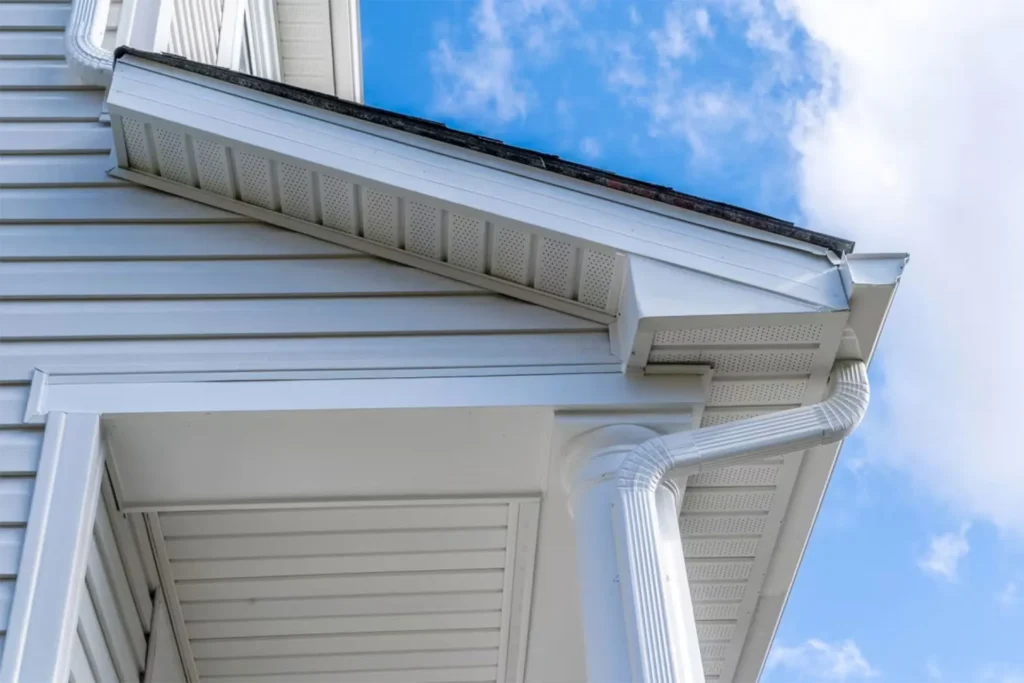
Soffit panels sit in front of the structural framing at your roof’s edge. The rafter tails — the ends of the rafters that extend beyond the wall to create the overhang — sit directly behind it. The sub-fascia, which the fascia board wraps, is attached to those rafter tails. When soffit fails and allows sustained moisture contact with that framing, the consequences work inward from the panel face.
What prolonged soffit failure does to the structure behind it:
- Rafter tail ends absorb moisture and begin to soften — the first structural timber to fail in this sequence
- Sub-fascia takes on moisture and weakens the attachment point for the fascia board and, by extension, the gutters
- Roof decking at the eave edge can be affected in cases of severe or long-standing intrusion
- Mold development in the framing can spread into the attic space if not addressed
What this means for a soffit repair call: Before we replace a single panel, we inspect the rafter tail and sub-fascia condition behind the damage. If the framing is sound, the repair is straightforward. If moisture has already reached the structural members, we tell you — with photos — what needs to happen before or alongside the soffit repair. Installing new panels over rotting rafter tails doesn’t fix the problem. It covers it up until the next inspection reveals something worse.
The ventilation side: The same inspection assesses whether the damaged soffit has disrupted your attic’s intake ventilation. Even a brief period of blocked or missing soffit can affect the attic environment. We confirm ventilation continuity as part of every repair assessment — and flag any section where vented panels need to be restored.
When Does Soffit Repair Make Sense — and When Does It Not?
The honest answer depends on what we find during the assessment. Here’s how we think about it.
We Recommend Repair When:
- Damage is localized — one or two elevations, isolated panel failures, or a specific impact/storm section rather than system-wide deterioration
- The rafter tails and sub-fascia behind the damage are structurally sound — the moisture hasn’t reached the framing, or the framing is early-stage and containable
- The existing material is mid-life — aluminum soffit with years of functional life remaining in the undamaged sections
- The ventilation circuit can be restored — blocked or solid-for-vented sections corrected without needing full-system tearout
- The cause is mechanical or storm-related — panel detachment, J-channel failure, or storm blow-off rather than progressive moisture-driven deterioration across the full run
We Recommend Replacement When:
- Deterioration spans the full perimeter — multiple elevations showing consistent failure rather than isolated sections
- The material is aged past the point of repair — old vinyl that’s brittle across its full run, or aluminum with widespread fatigue and deformation
- Rafter tail or sub-fascia damage is extensive — the structural repair scope required to support a localized soffit fix approaches the cost of replacement
- The system has been patched repeatedly — multiple previous repairs across different sections signal the material has reached end of life
- A full roof or exterior project is already underway — the labor overlap at replacement time is far more economical than returning for soffit as a separate project
What to Expect When You Call Us for Soffit Repair
Free Assessment: Panel, Structure, and Ventilation
We inspect the full visible soffit run — not just the section that's obviously damaged. We check rafter tail and sub-fascia condition behind the failure area, assess ventilation continuity across all elevations, and identify any related issues with J-channel, fascia, or gutter attachment. You receive a complete picture before any scope is agreed.
Straight Recommendation: Repair, Partial Replacement, or Full Replacement
Based on what we find, we give you a written recommendation with the reasoning behind it. If localized repair is the right call, we price it with material and scope clearly stated. If the damage has progressed to the framing or the material is at end of life, we tell you that — and show you what the fuller scope would look like and why.
Repair Execution: Panel, Structure, and Ventilation Restored
We replace damaged panels, address any J-channel or framing conditions identified in the assessment, restore vented coverage where blocked or incorrectly solid, and ensure all transitions at the wall and fascia edge are properly sealed against moisture and pests.
Final Walkthrough and Ventilation Confirmation
We walk the repaired elevations with you, confirm all panels are properly seated and sealed, and verify ventilation continuity has been restored where affected. All warranty documentation is provided at project close.
Why the Rafter Tail Inspection Changes What Gets Found
Most soffit contractors replace panels. Ohio Roof Masters repairs the system — and the soffit panel is just the surface of it. Here’s what that distinction looks like in practice.
The rafter tails and sub-fascia behind a failing soffit section are almost never assessed on a standard soffit repair call. Most contractors price the panel replacement from what's visible on the face and move on. Ohio Roof Masters probes the framing behind the damage before any scope is agreed. If the structure is sound, the repair is what it appears to be. If moisture has reached the framing, you see it in photos with a clear explanation of what it means and what addressing it would cost — before installation day, not during it.
Damaged or compromised soffit often disrupts attic intake ventilation — sometimes visibly (a panel has collapsed across a vented section), sometimes invisibly (a previous repair used solid panels where vented ones should be). Ohio Roof Masters holds a Lomanco Certified Ventilation Professional designation and checks ventilation continuity on every soffit repair assessment. If intake is disrupted, we restore it as part of the repair scope — not as an add-on discovered after the fact.
There's more margin in a full soffit replacement than in a repair call. We know that, and our process is built to prevent that incentive from influencing recommendations. If localized repair addresses the damage, restores ventilation function, and the framing behind it is sound, we'll tell you repair is the right call and price it accordingly. We recommend replacement only when the evidence makes it the more financially sound decision — widespread material degradation, structural damage that makes repair impractical, or a material that's at end of life across its full run.
Ohio Roof Masters uses aluminum for soffit repairs. When we replace damaged sections in an existing aluminum system, we match profile and color with aluminum stock — not vinyl substitutes that will age differently, respond differently to Ohio's temperature range, and look noticeably different within a few years. Where an exact color match isn't achievable on older material, we discuss the aesthetic implication before proceeding and give you options.
Soffit damage caused by Ohio's wind and hail events is often covered under homeowners insurance. Ohio Roof Masters documents storm damage with CompanyCam photo evidence, provides written scope tied to the damage assessment, and can support your adjuster evaluation with the documentation needed to make a valid claim. If your soffit damage is storm-related, we'll tell you what we find, how it documents, and whether your situation is likely to qualify — before you decide how to proceed.
Ohio Roof Masters has operated from the Miami Valley since 2017 with five physical office locations. We're a full exterior contractor, not a trim specialist — which means when we're on-site for a soffit repair, we're also looking at the adjacent fascia, the gutter above it, and the shingles overhead. If something related to the soffit failure warrants attention elsewhere on the edge system, you'll know about it during the same assessment. Local accountability means you get a contractor who understands the whole system — and will still be here when you need follow-up.
- What Our Customers Say
Real Reviews From Ohio Homeowners
We’ve earned our reputation one roof at a time. See why homeowners across Dayton, Troy, Springfield, and Sidney trust Ohio Roof Masters for their roofing needs.
EXCELLENTTrustindex verifies that the original source of the review is Google. A great experience! Marc's expertise is evident. Very respectful, professional, and knowledgeable. Answered every question I had.Posted onTrustindex verifies that the original source of the review is Google. Definitely 5 stars! Ohio Roof Masters is the best of the the best 👌 No hassle, no hidden costs. Marc was very accommodating, professional and communicative.Posted onTrustindex verifies that the original source of the review is Google. I have to say that Aaron Gearhart, my roofing specialist, directed this entire project very well. He worked with us against an extremely tight deadline to get us under roof just 1 day before the snow hit. I only gave him a few days notice, but they made it happen - when all the other 7 quotes I received said it would be 6-8 weeks to even start (or maybe not until next spring), Aaron and his crews had it done the very next week. Unbelievable save from these guys, as water had been leaking through to my master bedroom/bath unbeknownst to me until the day I called Aaron. He inspected everything as it was completed, probably 4 or 5 trips to my house, enough that I now consider him more than just my roof expert, but a good friend, after going through this together, he really saved the day and my whole fear of going into the winter with these leaks and water damage. Also, I cannot say enough praise for the 4 man crew that did the roof, or the 3 man crew that did my gutters/flashing/soffits, even the material delivery guys were great, and mostly these guys cleaned up/picked up every scrap of metal/wood/shingles from my entire yard without hesitation and without asking. Just wanted to leave my 2 cents on here in case it helps anyone who is on the fence about roof contractors, as I mentioned, I had selected Aaron's company after receiving different quotes from 8 different companies. Pricing was great, follow-up was great, they even scheduled a follow-up inspection 6 months ahead in the spring of 2026 just to make sure everything held up after the winter storms.Posted onTrustindex verifies that the original source of the review is Google. I had my roof replaced recently and the experience was fantastic. The crew showed up on time every day and worked efficiently without cutting corners. They were respectful of my property and cleaned up all debris before leaving. The roof looks great and I feel confident it will last for years. Excellent workmanship from start to finish.Posted onTrustindex verifies that the original source of the review is Google. I’m very pleased with the roofing service I received. The inspection was thorough and the estimate was fair. The team worked quickly and made sure everything was done correctly. I appreciated how they took the time to explain what needed to be fixed and why. I highly recommend their services to anyone needing roof work.Posted onTrustindex verifies that the original source of the review is Google. We had several leaks that other companies couldn’t seem to fix, but this contractor identified the real problem right away. They were knowledgeable, honest, and very skilled. The repair was completed in a timely manner and the leaks have not returned. It’s refreshing to deal with professionals who know what they’re doing.Posted onTrustindex verifies that the original source of the review is Google. From the first call to the final inspection, everything went smoothly. The roof was completed faster than expected and the quality is excellent. The workers were polite and kept the area neat throughout the job. I feel like I received great value and dependable service. Would absolutely recommend to friends and family.Posted onTrustindex verifies that the original source of the review is Google. Very satisfied with the entire experience! The crew showed up early, worked efficiently, and cleaned up completely afterward. The new roof looks beautiful and sturdy — you can tell it was done by pros.Posted onTrustindex verifies that the original source of the review is Google. I had a small leak repaired and was impressed by how quickly they responded. The technician was polite and explained what caused the issue. Affordable, honest, and reliable service — highly recommended!Posted onTrustindex verifies that the original source of the review is Google. Ohio Roof Masters transformed our home with a brand-new roof, and we couldn’t be happier. The entire process was smooth from start to finish. Excellent workmanship and outstanding customer service.
- Service Areas
Soffit Repair Across Central & Southwest Ohio
Five office locations across the Miami Valley and surrounding region mean local crews, faster response, and a company invested in the communities it serves.
Core Service Counties
Expanded Service Area
Not sure if we cover your area? Call (937) 418-7976 and we'll let you know right away.
Frequently Asked Questions
Soffit repair costs vary by the scope of damage, the number of elevations affected, and whether rafter tail or sub-fascia repair is needed behind the soffit panels. Isolated panel replacements are typically minor — a few hundred dollars for a localized section. Repairs that include structural framing work behind the soffit, full J-channel replacement on a full elevation, or ventilation restoration across multiple sections range higher. Ohio Roof Masters provides a written estimate after the free assessment, with each component of the scope priced separately so you can see exactly what you're paying for.
In most cases, yes — if the damage is localized and the framing behind it is sound. Individual panels can be replaced section-by-section with color-matched material. J-channel can be re-secured or replaced on a per-elevation basis. The repair-vs.-replace decision depends on how widespread the deterioration is, the material's remaining lifespan, and what the inspection finds behind the panels. We assess this during the free evaluation and give you a straight recommendation either way.
Sagging soffit is typically caused by J-channel that has separated from the wall or fascia edge, fastener failure in the framing behind it, or panels that have deformed from thermal cycling or moisture. In vinyl soffit, material fatigue over time causes panels to lose their grip in the channel. In older aluminum, long spans without adequate intermediate support can allow bow under wind load or ice weight. The specific cause determines the repair — we identify it during the assessment before quoting.
Yes, in two ways. First, soffit damage creates openings for moisture to reach the rafter tails and sub-fascia behind it — which are structural components of your roof's edge. Second, damaged or blocked soffit disrupts attic intake ventilation, which affects attic temperature regulation, moisture control, and shingle lifespan. In Ohio, inadequate attic ventilation also contributes to ice dam formation in winter. Ohio Roof Masters assesses both the structural and ventilation implications of soffit damage on every repair call.
Soffit damage caused by a qualifying storm event — wind, hail, falling debris — is typically covered. Deterioration from age or maintenance neglect is not. If your soffit damage is storm-related, Ohio Roof Masters documents the damage with photos and can support your insurance adjuster evaluation. We'll give you an honest read on whether your situation is likely to qualify as a claim during the assessment.
Vented soffit has perforations that allow outside air to enter the attic from the roofline's lower edge. Solid soffit does not. They look nearly identical from the ground, which is why a previous repair using solid panels to replace vented ones is one of the most common and least visible soffit problems. It matters because vented soffit is the primary intake source for your attic ventilation system. If intake is blocked or reduced, attic heat and moisture accumulate — with consequences for shingle lifespan and manufacturer warranty compliance. We verify ventilation type and continuity on every soffit assessment.
- Contact
Soffit That Looks Damaged Has Usually Been Working Against You for Longer Than It Looks
By the time soffit is visibly failing — sagging, cracked, stained, or open at the edge — the conditions that caused it have typically been present for more than one season. In Ohio’s climate, one wet fall and winter is enough for moisture that’s reached rafter tails to begin the softening process. Acting on visible soffit damage sooner rather than later keeps the repair scope narrow and the cost proportionate.
The free assessment takes less than an hour. You’ll leave it knowing what’s actually failing, what condition the framing behind it is in, whether your attic ventilation is affected, and what repair — or replacement — would specifically cost. There’s no commitment required to get that information.
What Your Free Assessment Includes:
- Full soffit inspection across all visible elevations
- Rafter tail and sub-fascia condition check behind damaged sections
- Ventilation continuity assessment — vented vs. solid coverage confirmed
- Storm damage documentation if applicable for insurance
- Written estimate with each scope item priced separately
- Straight repair vs. replace recommendation with the reasoning explained
- No commitment required — 7-day satisfaction guarantee after signing